
Healthcare · CV Template
Physiotherapist & Physio CV Example
By the WhizCV team
A physiotherapist's CV has to prove clinical outcomes and HCPC registration together. Employers screen for your physiotherapy qualification, HCPC registration, treatment specialties, and evidence that your patients regain function and meet their goals.
No card · free forever · PDF download included
Or try it without signing up →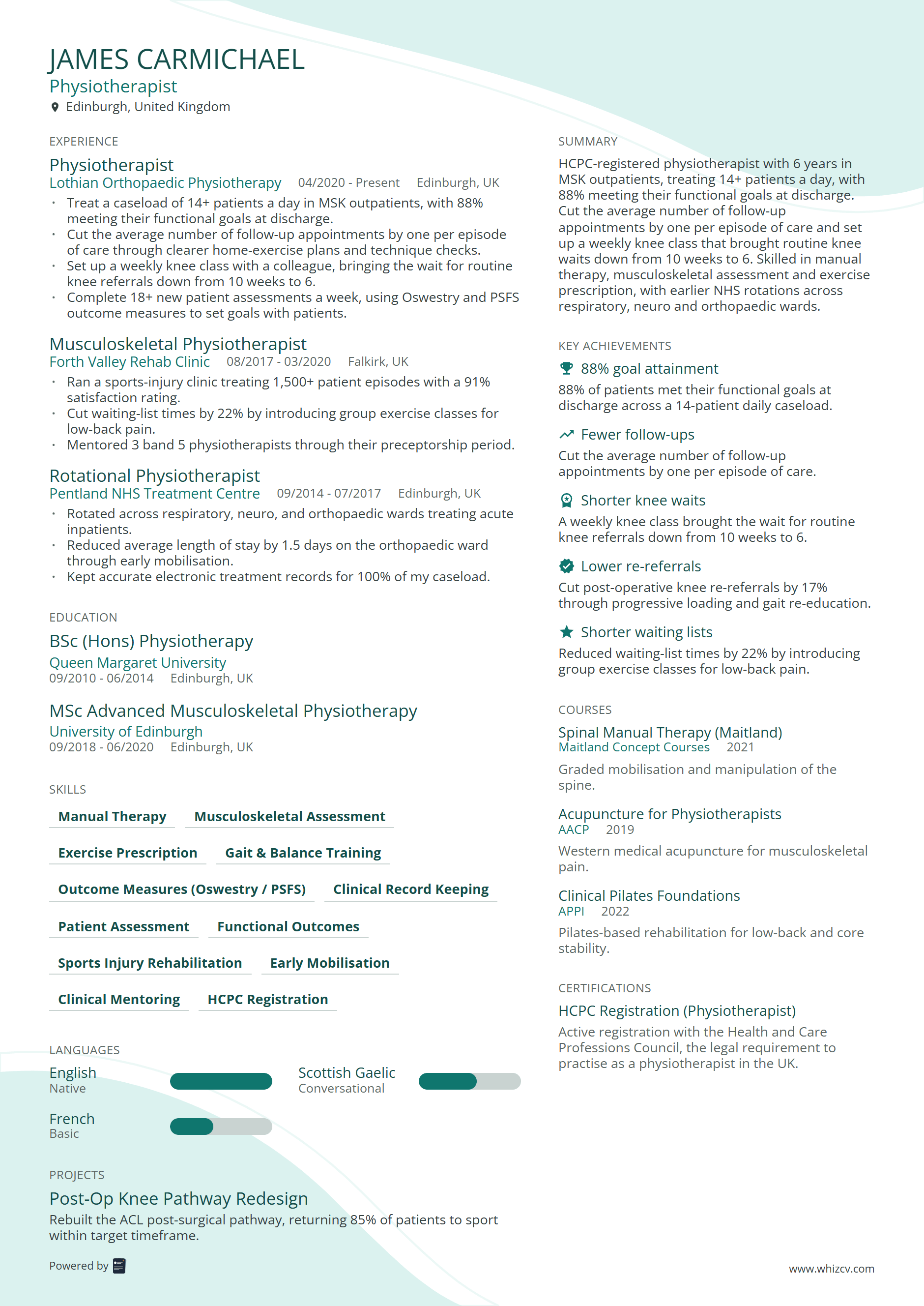
Full Physiotherapist CV examples
Written by the WhizCV team · fictional person · figures are illustrative
Sophie Turner
Graduate Physiotherapist
[Town]07700 900205sophie.turner@example.com
Profile
Newly qualified physiotherapist with a BSc (Hons) Physiotherapy. My placements covered musculoskeletal outpatients, an acute respiratory ward and community rehabilitation after strokes and falls. I am looking for a band 5 rotational post.
Registration
HCPC registered, physiotherapist · [Registration number]
Clinical placements
Student Physiotherapist · Example NHS Trust, MSK outpatients
- Assessed and treated my own list of patients with back, knee and shoulder problems, under supervision.
- Taught home exercise programmes and checked technique at follow-up appointments.
Student Physiotherapist · Example NHS Trust, respiratory ward
- Gave chest physiotherapy and got acutely unwell patients moving again myself, with my practice educator on hand.
- Reported on patients' mobility at the daily board round to help plan safe discharges.
Student Physiotherapist · Example Community Rehabilitation Team
- Visited patients at home after a stroke or a fall and worked on transfers, walking and stairs.
Other experience
Healthcare Assistant (bank) · Example NHS Trust
- Work weekend shifts on medical wards, helping patients wash, eat and move safely.
Education
BSc (Hons) Physiotherapy · [University], 2026
Dissertation: [title, in one line]
Skills
Subjective and objective assessment · Exercise prescription · Chest physiotherapy · Moving and handling · Outcome measures · Clear notes
Oliver Grant
Musculoskeletal Physiotherapist
[Town]07700 900318oliver.grant@example.com
Profile
HCPC-registered physiotherapist with six years' experience, the last four in NHS musculoskeletal outpatients. I assess and treat spinal, shoulder and knee problems, run a weekly exercise class and supervise students on placement.
Registration and membership
HCPC registered, physiotherapist · [Registration number] · MCSP
Experience
Band 6 Physiotherapist, MSK outpatients · Example NHS Trust
- Run a full clinic of new and follow-up patients with spinal, shoulder and knee problems.
- Use patient-reported outcome measures at the first and last appointment and go through the results with patients.
- Set up a weekly knee exercise class with a colleague, which freed up one-to-one appointments.
- Act as practice educator for physiotherapy students on placement.
Band 5 Rotational Physiotherapist · Example NHS Trust
- Rotations in respiratory care, orthopaedic wards, stroke rehabilitation and MSK outpatients.
Education and training
BSc (Hons) Physiotherapy · [University], 2020
[Postgraduate course or master's module, as completed]
Skills
MSK assessment · Exercise prescription · Manual therapy · Group classes · Outcome measures · Student supervision
Joanna Webb
First Contact Physiotherapist, MSK
[Town]07700 900542joanna.webb@example.com
Profile
Physiotherapist with thirteen years' experience, now working as a first contact practitioner in general practice. Patients with muscle and joint problems book straight in to see me instead of a GP. I also lead a small team of physiotherapists across the network.
Registration and membership
HCPC registered, physiotherapist · [Registration number] · MCSP
Experience
First Contact Physiotherapist · Example Primary Care Network
- Assess and manage adults with muscle and joint problems as their first appointment at the practice.
- Refer on to orthopaedics or rheumatology and request imaging where needed, following local pathways.
- Lead a team of four first contact physiotherapists and run their monthly case reviews.
- Audited onward referrals from my clinics and shared the results with the practices.
Band 7 Clinical Specialist Physiotherapist · Example NHS Trust
- Led the spinal clinic and supervised band 5 and 6 physiotherapists.
Physiotherapist, bands 5 and 6 · Example NHS Trust
Education
MSc [Advanced practice or musculoskeletal physiotherapy, as awarded] · [University], 2020
BSc (Hons) Physiotherapy · [University], 2013
Skills
First contact assessment · Clinical reasoning · Referral pathways · Team leadership · Audit · Teaching
How to structure your Physiotherapist CV
- Registration: your HCPC registration and number under your name, plus MCSP if you are a chartered member.
- Profile: your setting (MSK, respiratory, neuro, community, private practice) and the patients you see, in two or three lines.
- Experience: posts newest first, with your band or level, the setting, and the assessments and treatments you do.
- Education and training: your degree or apprenticeship, then courses since qualifying, like a master's module.
- Teaching, audit and service work: students you supervise, audits you ran and classes you set up. Brief, but it shows you are ready for a more senior post.
No paid experience yet?
New graduates are hired on their placements. Treat each one like a short job and show what you did with your own patients.
- List every placement with the setting and year, and say what you did yourself under supervision.
- Add healthcare assistant, care or sports club work. It shows you are used to patients and shifts.
- Put your HCPC registration near the top. If your application is still being processed, say so.
- Name the assessment tools and outcome measures you have used.
Qualifications and checks to list
Each card links to the body that awards or regulates it. Check the current requirements there before you apply.
HCPC registration
The HCPC regulates physiotherapists in the UK. 'Physiotherapist' and 'physical therapist' are protected titles, so you must be on its register to use them.
Source: Health and Care Professions Council ↗Chartered membership (MCSP)
Membership of the Chartered Society of Physiotherapy, open to HCPC-registered physiotherapists, with the MCSP letters. The CSP says many employers require or prefer it.
Source: Chartered Society of Physiotherapy ↗Common mistakes
Registration missing or buried
Only people on the HCPC register can call themselves a physiotherapist. Put your registration where a manager sees it first.
Treatments without a setting
'Manual therapy, exercise prescription' says little on its own. Say who you treated, where, and what changed.
Placements in full detail for years
Once you have a few years in post, cut placements to one line and let your jobs carry the page.
Physiotherapist CV professional summary example
Open with two or three lines covering what you do, how long you have done it, and one measurable result.
HCPC-registered physiotherapist with 6 years in MSK outpatients, treating 14+ patients a day, with 88% meeting their functional goals at discharge.
Core skills for a Physiotherapist CV
The skills worth naming in your skills section. Different from the ATS keywords below, which are the terms a parser scans for.
- Manual therapy
- Musculoskeletal assessment
- Exercise prescription
- Gait & balance training
- Outcome measures (Oswestry / PSFS)
- Clinical record keeping
How to write a standout Physiotherapist CV
Three things hiring managers and applicant tracking systems look for — get these right and you clear the first screen.
Lead with your qualification and HCPC registration
State your physiotherapy degree and HCPC registration up front. You cannot practise under the title without registration, so it is the first thing an employer checks.
Show functional outcomes
Physiotherapists are judged on results. Name the outcome measures you use (Oswestry, PSFS, LEFS, Berg Balance) and what they showed, or how many patients met their goals by discharge.
Name your setting and specialties
Specify MSK outpatients, neuro, respiratory, paediatrics or community work, plus CSP membership and postgraduate courses. It helps employers match you to their caseload.
ATS keywords for Physiotherapist CVs
Applicant tracking systems scan for role-specific terms before a human reads your CV. Weave the ones that genuinely apply to you into your summary, skills, and bullets.
Physiotherapist CV bullet point examples
Achievement-led bullets that show impact with numbers — concrete beats vague. Adapt them to your own results.
- Treated a caseload of 14+ patients a day in MSK outpatients, with 88% meeting their functional goals at discharge.
- Cut the average number of follow-up appointments by one per episode of care through clearer home-exercise plans and technique checks.
- Set up a weekly knee class with a colleague, bringing the wait for routine knee referrals down from 10 weeks to 6.
Frequently asked questions
Common questions about writing a Physiotherapist CV.
What should a physiotherapist put on a CV?
Your physiotherapy degree, HCPC registration, treatment setting and specialties, caseload, outcome measures and results, and any CSP membership or postgraduate training.
Which outcome measures should I mention?
Name the standardised tools you use, such as Oswestry, PSFS, LEFS or Berg Balance, and quote score improvements or the share of patients meeting their goals at discharge.
Do postgraduate qualifications matter?
Yes. CSP membership, postgraduate courses and a master's in your field show continued development and help your CV stand out for more senior posts.
Related CV templates
Exploring nearby roles? These templates are popular too.
Build your Physiotherapist CV in minutes
Start from this template, let AI sharpen your bullet points, and download a polished PDF — free.
Edit this template free →No card · free forever · PDF download included
Or try it without signing up →