
Engineering · CV Template
Biomedical Engineer CV Template & Example
A biomedical engineer CV has to prove you can develop medical devices that are both effective and compliant: designs verified, regulations met, and patients kept safe. Employers look for design controls, regulatory standards, and devices you have moved through the development lifecycle, so pair engineering depth with regulatory fluency.
No card · free forever · PDF download included
Or try it without signing up →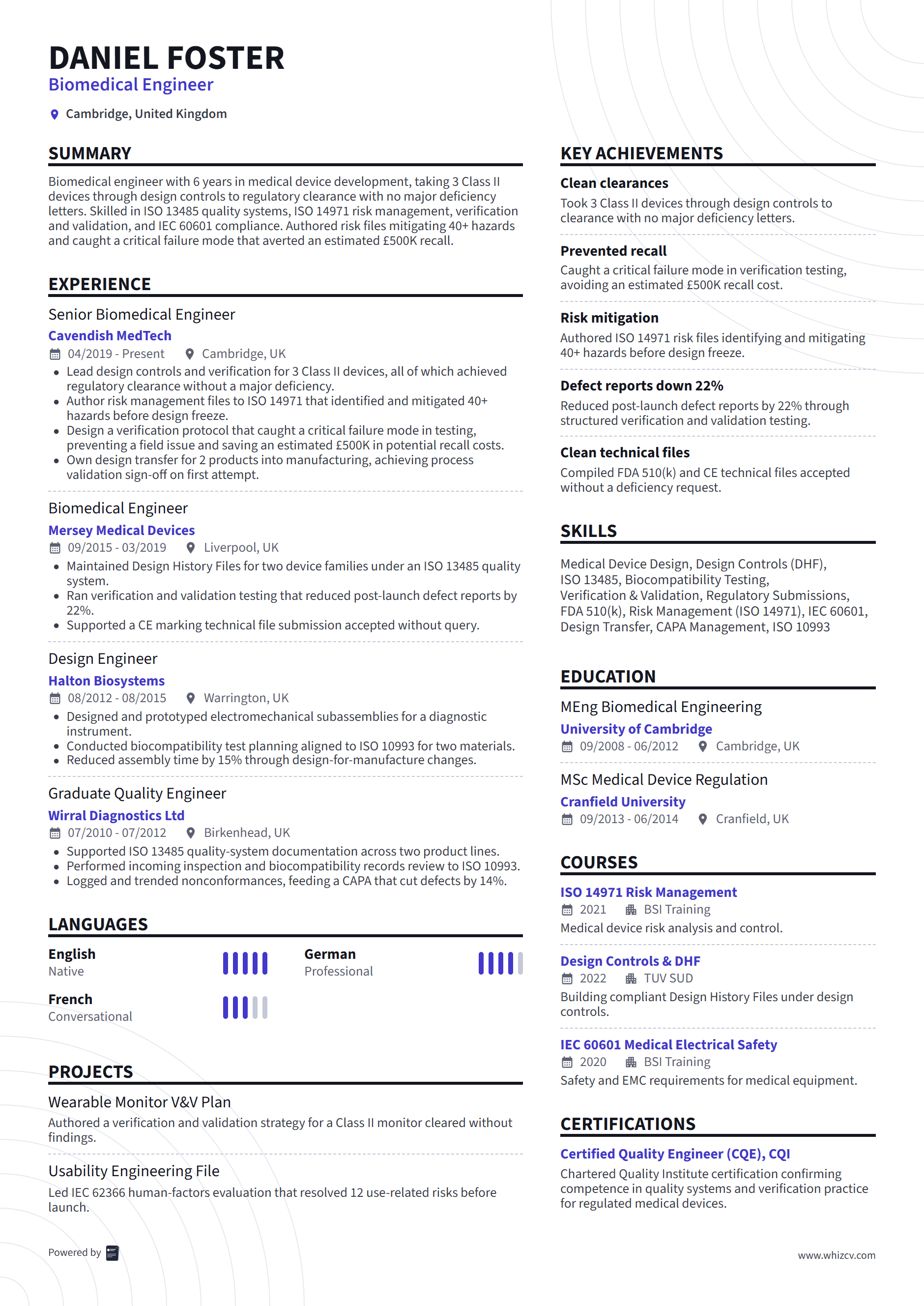
Biomedical Engineer CV professional summary example
Open with two or three lines covering what you do, how long you have done it, and one measurable result.
Biomedical engineer with 6 years in medical device development, taking 3 Class IIa devices through design controls to CE marking and UKCA technical file approval.
Core skills for a Biomedical Engineer CV
The skills worth naming in your skills section. Different from the ATS keywords below, which are the terms a parser scans for.
- Medical device design
- Design controls (DHF)
- ISO 13485
- Biocompatibility testing
- Verification & validation
- Regulatory submissions
How to write a standout Biomedical Engineer CV
Three things hiring managers and applicant tracking systems look for — get these right and you clear the first screen.
Show regulatory fluency
Med-device hiring lives and dies on compliance. Name the standards you work under such as ISO 13485, IEC 60601, and ISO 14971, and any CE marking, UKCA, or FDA 510(k) submissions you supported.
Demonstrate the design control lifecycle
Employers want engineers who can manage a Design History File. Highlight design inputs, V&V, risk management, and design transfer on devices you developed.
Quantify device outcomes
Tie work to results: devices approved, defects caught in V&V, biocompatibility passes, or cycle-time reductions. Concrete outcomes separate you from candidates who only list duties.
ATS keywords for Biomedical Engineer CVs
Applicant tracking systems scan for role-specific terms before a human reads your CV. Weave the ones that genuinely apply to you into your summary, skills, and bullets.
Biomedical Engineer CV bullet point examples
Achievement-led bullets that show impact with numbers — concrete beats vague. Adapt them to your own results.
- Led design controls and verification for 3 Class IIa devices, all of which achieved CE marking and UKCA technical file approval without a major review finding.
- Authored risk management files to ISO 14971 that identified and mitigated 40+ hazards before design freeze.
- Designed a verification protocol that caught a critical failure mode in testing, preventing a field issue and saving an estimated £500K in potential recall costs.
Frequently asked questions
Common questions about writing a Biomedical Engineer CV.
What should a biomedical engineer CV include?
Medical device design experience, the regulatory standards you work under such as ISO 13485 and IEC 60601, design control and V&V work, and devices you have moved toward CE marking, UKCA, or international approval.
How important is regulatory experience for a BME CV?
Very important. Employers prioritise candidates who understand design controls, risk management, and submissions like CE marking or UKCA, since non-compliance can halt a product launch.
What if my experience is academic rather than industry?
Highlight relevant research, instrumentation, and any work touching standards or validation. Translate lab projects into device-development language such as design inputs, testing, and risk.
Related CV templates
Exploring nearby roles? These templates are popular too.
Build your Biomedical Engineer CV in minutes
Start from this template, let AI sharpen your bullet points, and download a polished PDF — free.
Edit this template free →No card · free forever · PDF download included
Or try it without signing up →